

15 Sep Rand Sandton Consulting Group backs Mozambique’s push to act on illicit financial flows
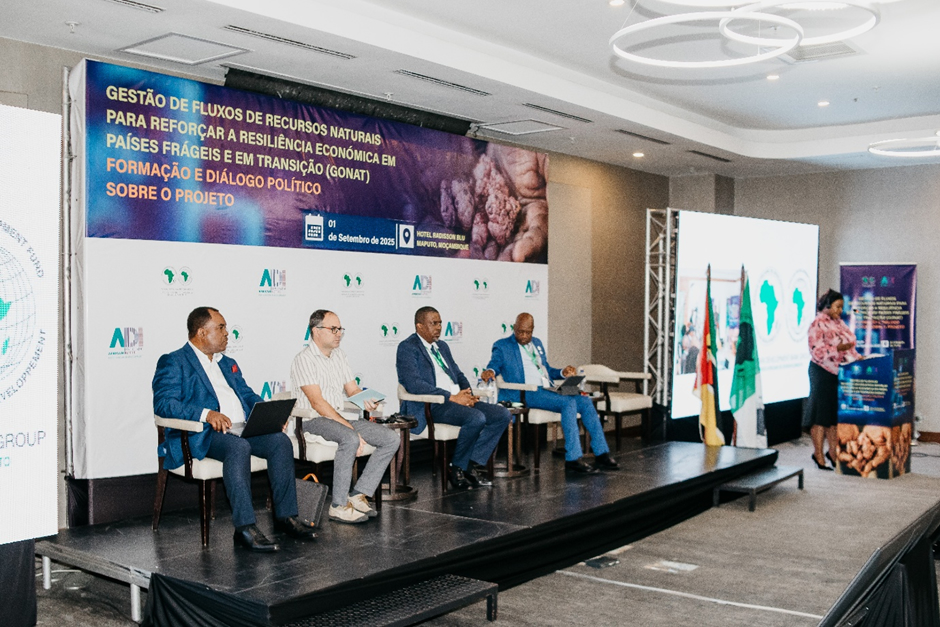
Panel photo: from left to right: Dr Salvador Mondlane, professor in the Department of Geology, Faculty of Sciences, Universidade Eduardo Mondlane, Mozambique; Mr Daniel Rinerio Research/ Technical Officer, Justiça Ambiental! (JA!), Mozambique; Mr Noa Inacio, Executive Assistant of the Extractive Industries Transparency Initiative (EITI) Mr. José Mendes President, Geological Mining Association of Mozambique, Ms Fewstancia Munyaradzi Executive Durector Rand Sandton Consulting Group moderating the session.
Rand Sandton Consulting Group facilitated the technical session on behalf of the African Development Bank at the one-day GONAT policy dialogue held at the Raddison Blu Hotel in Maputo on 1 September 2025. The event, run under the GONAT banner “Governing Natural Resource Outflows for Enhanced Economic Resilience,” focused on turning country diagnostics into clear measures to stop illicit financial flows (IFFs) from Mozambique’s forests, fisheries and mines.
The African Development Bank’s representative opened with a blunt figure: Mozambique lost “about USD 26.4 million in 2016 alone” to illicit outflows. That estimate set the scene for discussions about how lost resource value reduces money for public services and jobs.
H.E. Roberto Albino, Minister of Agriculture, Environment and Fisheries, warned that both visible and hidden crimes take value from the country. He said Mozambique’s natural wealth including about 34 million hectares of forest is under pressure and that over 30% of fishing activity is illegal. On timber policy he was clear: “next year will be the last year for Mozambique to export raw timber.” The minister said stopping raw exports and pushing for local processing will help keep jobs and earnings in Mozambique.
H.E. Salim Cripton Valá, Minister of Planning and Development, spoke about the risks of resource-backed loans. He noted RBLs can finance needed projects but cautioned that “lenders often hold informational advantages and control commodity pricing.” He called for full transparency on loan terms, better negotiation skills in government, and parliamentary oversight to avoid mortgaging future revenues.
Legal and enforcement gaps were highlighted. Dr. Angelina Mulilo, lawyer and mining law lecturer, said plainly: “Laws are in place, but there is a lack of conviction and punishment of culprits.” That enforcement gap, she warned, lets illegal exports and corruption continue.
Rand Sandton Consulting Group’s Managing Director, Ms. Fewstancia Munyaradzi, served as the technical session moderator, where industry voices called for practical fixes. José Mendes, President of the Geological Mining Association of Mozambique, urged reference pricing and more explicit export rules, warning that intent without follow-through is not enough: “the willingness is there, but there is no action on the ground.” He and others supported publishing contracts and creating beneficial ownership registries, so it is harder to hide illicit activity.
The technical panel focused on tools that can be used now: digitise the National Forestry Information System; link customs, tax and licensing databases to spot mismatches; increase drone and satellite monitoring in remote areas; and train staff in data analysis and forensic auditing so these systems are used effectively.
Other practical proposals discussed included reviewing older tax and investment treaties that enable profit shifting, promoting local processing of timber and minerals to capture more value at home, and exploring carbon credits to reward forest protection. Mr Daniel Rinerio, Research and Technical Officer at Justiça Ambiental! (JA!), Mozambique urged a national anti-IFF strategy and a standing inter-agency task force that brings Finance, Tax, Customs, Anti-Corruption and environmental bodies together for coordinated action.
A clear message ran through the dialogue: many solutions are known, but weak enforcement and low technical capacity stop change. As one speaker put it during the meeting, “the willingness is there, but there is no action on the ground.” Panelists called for public reporting so citizens can track progress and for stronger accountability summed up in the line from the meeting: “justice in contracts is required.”
The forum closed with a direct Call to Action: adopt a sequenced national plan to curb illicit flows, invest in digital monitoring and capacity building, tighten transparency rules on contracts and ownership, and ensure communities receive the revenue share meant for them. Rand Sandton Consulting Group continue to support efforts to move from diagnostics to delivery so Mozambique can keep more of its natural wealth working for its people.