

14 Aug Rand Sandton Supports Natural Resource Governance Reform in Chad under AfDB-GONAT Partnership
Rand Sandton Consulting Group and the African Development Bank (AfDB) co-facilitated a high-level policy dialogue in N’Djamena, Chad, from 22 to 25 July 2025, as part of the AfDB-funded Governing Natural Resource Outflows for Enhanced Economic Resilience (GONAT) initiative. Hosted in partnership with the Government of Chad, the event marked the culmination of a two-day capacity-building workshop focused on strengthening transparency and accountability in natural resource management.
Held at the Radisson Blu Hotel, the event brought together 50 key stakeholders including government officials, civil society, academia, and the private sector. The GONAT initiative, launched in 2023, aims to build country-level capacity to tackle illicit financial flows (IFFs) and manage resource-backed lending more transparently. Chad is the third country to host this in-country engagement following earlier sessions in the Central African Republic and Sierra Leone.
The programme was structured into two main components: a two-day technical training followed by a high-level policy dialogue. The technical sessions, facilitated by Rand Sandton’s Dr. Bernd Schlenter, Senior IFF expert, equipped participants with governance tools to enhance fiscal transparency and accountability in the extractive sector. Topics included natural resource accounting, tracking trade transactions, identifying IFFs, and inter-agency coordination. Legal and fiscal frameworks were also explored, particularly those necessary to safeguard extractive contracts and align resource-backed loan negotiation with the Sustainable Development Goals.
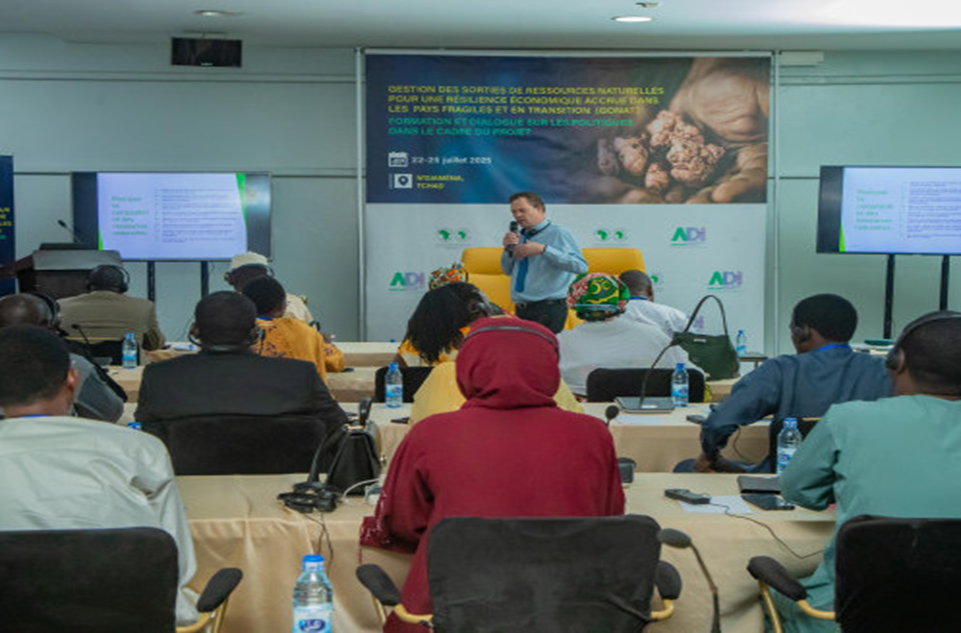
Dr Bernd Shlenther – Rand Sandton Consulting Group’s Senior IFF expert delivering training on the GONAT Project
Participants highlighted practical challenges such as data gaps in the informal gold mining sector, revenue losses through tax loopholes, and limited institutional oversight. Proposed responses included improving data systems, formalizing artisanal mining operations, and reforming tax incentives to improve revenue retention.
“Strengthening overall governance and transparency in the natural resource sector is a necessary step in reforming the design, governance, monitoring, and implementation of IFFs, illegal natural resource trade, and resource-backed lending in Africa. The GONAT initiative is helping address these issues and ensuring that Africa harnesses its natural wealth for resilient growth and development,” said Solomane Koné, Director of the African Natural Resources Management and Investment Centre at the African Development Bank, in his opening remarks.
On the final day, a policy dialogue brought together decision-makers and stakeholders to reflect on the training outcomes and discuss national-level strategies. The dialogue, moderated by Dr. Innocent Onah of the AfDB, addressed illicit trade, mispricing of exports, and the fiscal risks of resource-backed financing. Technical perspectives were provided by Prof. Abdallah Mahamat-Nour of the University of N’Djamena, who emphasized the value of multidisciplinary approaches that integrate hydrogeology, public finance, and transparency for sustainable resource management.
In her intervention, H.E. Ms. Kadidja Hassane Abdoulaye, Secretary of State for Petroleum, Mines and Geology, stressed the urgency of formalizing Chad’s mining sector and enforcing ownership declaration requirements introduced in 2023. She also acknowledged persistent corruption challenges and emphasized the need for stronger multi-sector collaboration.
Mr. Ahmat Abderahim Abbo, Secretary General for Economy and Planning, echoed these concerns and called for increased local value addition and better alignment between external support and Chad’s national development priorities.
“Illicit financial flows are one of the major obstacles to development in Africa. According to the African Development Bank’s African Economic Outlook, the continent loses an average of nearly $90 billion annually due to IFFs — about 4% of its GDP,” said Eric Ogunleye, Director of the Bank’s African Development Institute.
The dialogue also emphasized gender-responsive governance. “The workshop enhanced our understanding of illicit financial flows and underscored the need for an inclusive approach. Achieving sustainable and equitable development requires the meaningful involvement of women at all levels of natural resource governance,” noted Nguema Nakoye Mannta, Field Officer at the Ministry of Environment, Chad.
Closing remarks were also delivered by Dr. Solomane Koné, who reaffirmed the African Development Bank’s commitment to supporting Chad in its pursuit of resilient, transparent, and accountable natural resource governance systems.
Rand Sandton’s engagement in Chad reflects its broader mission to support African countries through tailored advisory services, data-informed policy tools, and multi-sectoral coordination advancing governance systems that are equitable, resilient, and aligned with national development priorities.